
On the cover: the argument in question, 3 and 4 September 2026.
On the third of September, Massimo posted one of those charts about how fast chess explodes. Twenty moves to start with. Over 400 after one move each. Around 8,900 by the third. Nearly 200,000 by the fourth. Underneath it, a hand-drawn game tree from the era when people drew these by hand.
Elon Musk replied that the number of moves in chess that aren’t utterly stupid is tiny, and that “chess will be fully solved one day”.
Hold on to those four numbers, because there is already a mistake in them, and it is the same mistake the next two days of argument were built on. They count orders in which moves can be played, not distinct arrangements of the board. Play 1.Nf3 Nf6 2.Ng1 Ng8 and both sides are back exactly where they started, having achieved nothing whatsoever, and that counts as a fresh sequence. It is plainly not a fresh board.
The published counts are 20, 400, 8,902 and 197,281, and every one of them is counting sequences.
Chess.com then arrived with a bigger number: there are more possible chess games than atoms in the observable universe, by about forty orders of magnitude, and “to solve chess, you’d have to map them all”.
Musk corrected them, correctly. Games and positions are different things, and legal positions come in about forty orders of magnitude below the atom count, not above. He added that a superintelligence will find ways to solve and compress the problem that we could not begin to follow, and signed off by noting he was arguing with a random intern at a chess website.
So one side was counting sequences, the other was counting arrangements, and both were sure the other was innocent of arithmetic. Six million people watched this and, as far as I can tell, not one of them said the thing that actually settles it.
Welcome to the difference between playing a game and solving one. This is the story of why a proof can be astronomically smaller than the tree it is a proof about, and why chess is still unsolved for a reason that has nothing to do with the size of the universe.
Paths and nodes
Draw the game tree properly and the whole confusion evaporates.
The root is the starting position, every edge is a legal move, and every node is the position you arrive at. A game is one path from the root down to a leaf where somebody is mated or the draw rules bite. A position is a node.
Why do paths outnumber nodes, and by so much? Because different move orders land on the same arrangement of pieces, so many paths run through the same node. Chess programmers call this a transposition, and they call those counts from the opening post perft, short for performance test, used to check that a move generator has not lost its mind. The wiki that publishes them says outright that what is counted is move paths. The tree counts the knight shuffle from a moment ago as a new thing, and the board is still the board.
- Paths, all the way down: about $10^{120}$. Shannon’s estimate.
- Distinct nodes: about $4.82 \times 10^{44}$.
- Atoms in the observable universe: about $10^{80}$.
Chess.com’s forty orders of magnitude above the atoms is right, for paths. Musk’s forty below is roughly right, for nodes; the real gap is nearer 36. That is two accurate numbers describing two different objects, fired at each other for two days.
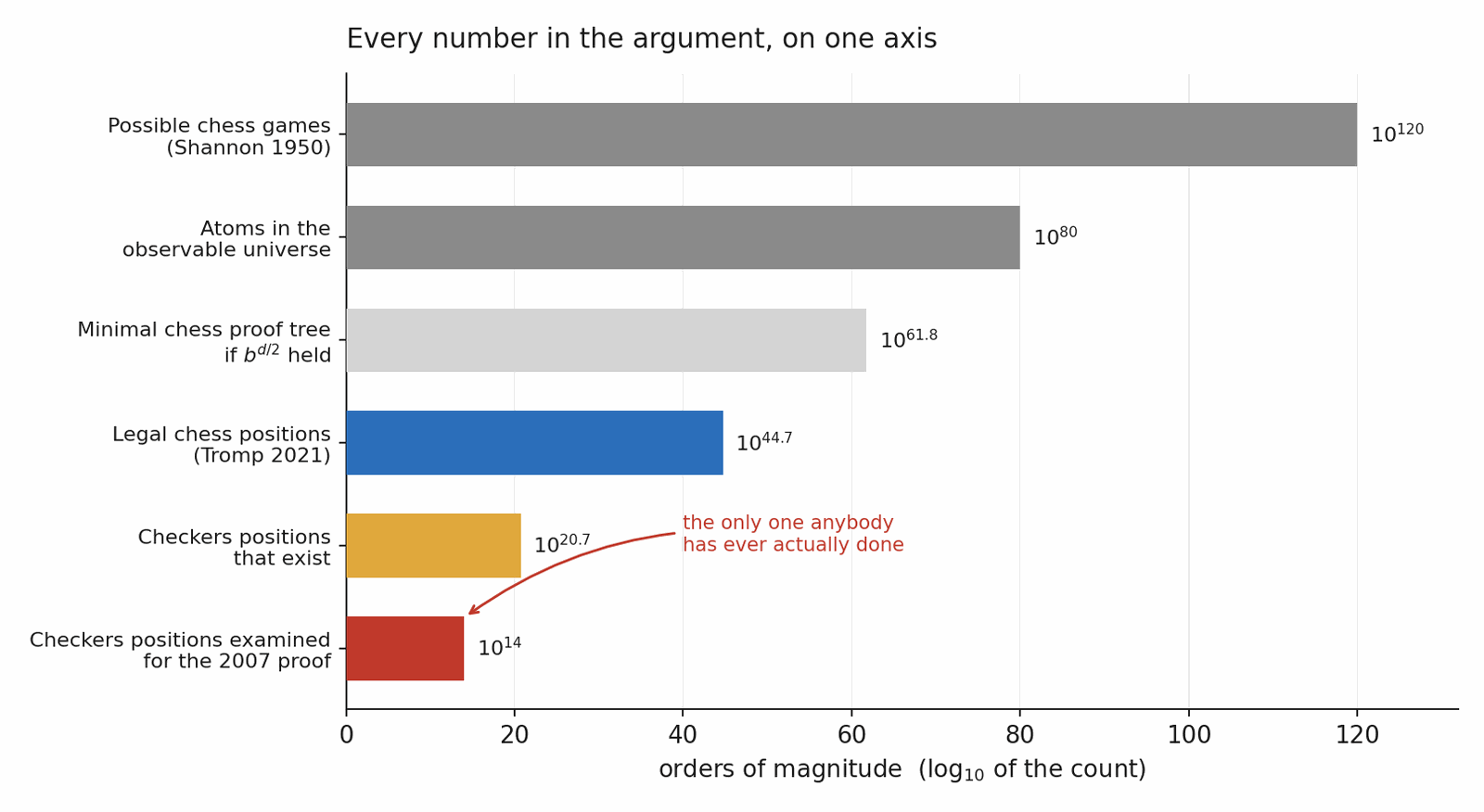 Figure 1: Every number anyone quoted, as orders of magnitude. The bottom bar is the only quantity here that a human being has ever finished computing. Source: Author
The two are not even the same kind of number. Shannon’s $10^{120}$ is a napkin, from Programming a Computer for Playing Chess in 1950: take forty moves a side and about thirty options each, so a move-pair contributes $30 \times 30 \approx 10^3$, and forty of those gives $(10^3)^{40} = 10^{120}$. That is the entire derivation, and there is no error bar because it was never meant to carry one. Shannon wanted to show brute force was hopeless, and it was.
The node count is a real measurement, and it is the better story.
Counting nodes nobody has
So how do you count distinct chess positions when nobody has the list and nobody ever will? John Tromp’s answer was to not count them at all, and measure instead.
Think of measuring a lake with a wiggly shoreline. Draw a rectangle around it whose area you know exactly, throw darts uniformly, and see what fraction land in water. Five percent wet means the lake is five percent of the rectangle, and you never had to trace the coast.
The rectangle here is a bigger, sloppier set: every way of arranging pieces on a board plus the extra state, including arrangements no real game could ever produce. Its size is a closed-form product and comes to $N \approx 8.7 \times 10^{45}$. A short Haskell program prints it in under ten seconds.
Then comes the dart. You cannot sample uniformly from $10^{45}$ things by shuffling them, so you number them: an invertible ranking, a bijection between the integers $0 \ldots N-1$ and the arrangements. A random dart becomes a random integer, which is free. Building that bijection is the real contribution of Tromp’s work, stitched together from fourteen smaller ranking functions with names like sandwichRanking and epOppRanking.
Then check each dart for legality, meaning some path from the root actually reaches it. Across two million samples, 5.53% came back legal:
\[L = (4.82 \pm 0.03) \times 10^{44} \quad \text{at 95\% confidence}\]NOTE: the ranked objects are not quite positions. Tromp calls them urpositions, and one position can be hit by several ranks, so each hit is weighted by the inverse of that multiplicity. The average correction is about 0.98, small enough to skip in conversation and not small enough to skip in the code.
There is a sting here. Deciding whether a node is even reachable means retrograde analysis, reasoning backwards about a position’s past rather than forwards about its future, and that has been proven PSPACE-hard on arbitrarily large boards. Throwing the darts is itself a hard problem.
One honest caveat before anyone quotes that at a party. Complexity classes describe families that grow with input size. Standard chess is 8x8 and finite, so formally it is a constant, solvable in $O(1)$ by a lookup table you would merely have to build first. The theorem says the difficulty is structural rather than a failure of imagination, and it says nothing about whether 8x8 chess is intractable.
What “solved” actually means
Now the part that decides the argument, and it is not about size at all.
Solving means more than finding the line both sides play when both play perfectly. That line is one path, and it would be worthless the instant your opponent stepped off it.
A solution is a strategy, and it has to survive anything the other side does. There are two grades of it:
- A weak solution gives the value of the root, plus a strategy that achieves it against every defence.
- A strong solution gives perfect play from every node, the complete answer book.
Both readings of “perfect play” are true at once, which is where people tie themselves up. Chess has three possible values: White wins, Black wins, draw. A solution assigns one of those to the root, and that single word is the both-play-perfectly answer. But what earns the word is a strategy covering every branch. The one-word answer is cheap to state and the strategy is what costs, and it is the cost of the strategy that this whole argument is about.
The shape of a proof
Here is why a proof is a small fraction of the tree it settles.
At nodes where the opponent moves, you need an answer to every edge, all of them, because the opponent picks and not you.
At nodes where you move, you need one edge that works. Find a good reply and every sibling edge falls out of the proof, because you were never obliged to play them.
Branch wide on their turns, branch by one on yours, and that asymmetry is the whole reason solving anything is possible at all.
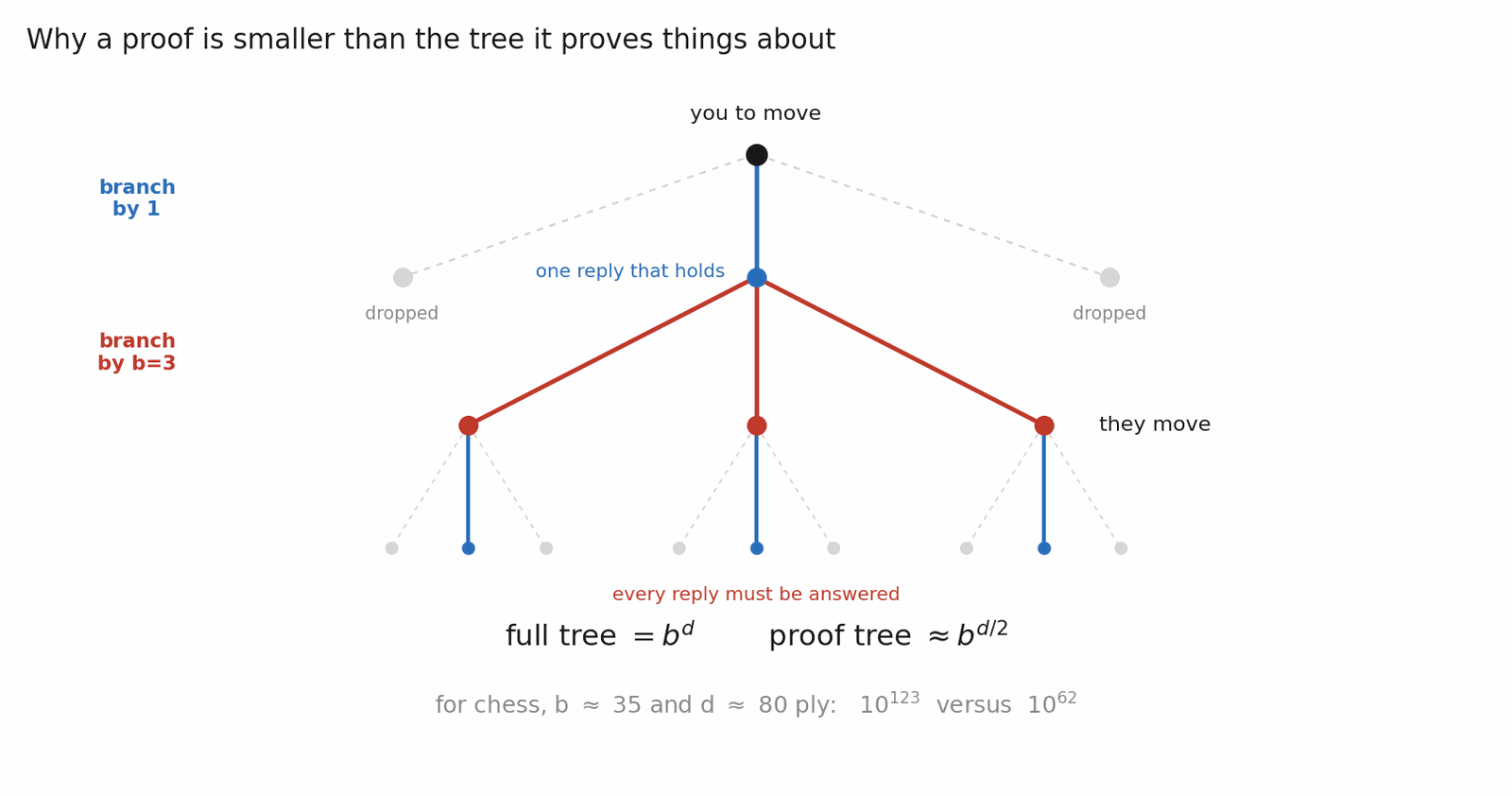 Figure 2: The proof keeps every edge on the opponent’s turns and one edge on yours. Dashed grey edges are moves you are allowed to never think about. Source: Author
If the branching factor is $b$ and the game runs $d$ plies deep, the full tree has $b^{d}$ leaves while the minimal proof tree has roughly
\[|P| \approx b^{d/2}\]the square root, which is the same bound Knuth and Moore proved for alpha-beta pruning in 1975.
It is worth feeling the exponents. Chess has $b \approx 35$ and a game runs about 80 ply, a ply being one move by one side. The full tree is $35^{80} \approx 10^{123}$, which is Shannon’s number arrived at from a different direction. The square root is $35^{40} \approx 10^{62}$. That is sixty orders of magnitude off the top, for free, from one observation about whose turn it is.
$10^{62}$ is still ridiculous. But notice it now sits above the node count of $10^{44}$, which caps it, since a proof that revisits a position can look it up instead of re-deriving it. So the governing quantity is somewhere below $10^{44}$, and exactly where is the question nobody can answer. That number, not either of the two in the screenshots, is what decides whether Musk is right.
Checkers, the only one anybody has finished
We have one worked example, and it is the reason Musk’s side of this is not silly.
Checkers has about $5 \times 10^{20}$ nodes. Jonathan Schaeffer’s team at Alberta spent 18.5 years on it and announced in April 2007 that checkers is solved. Perfect play is a draw.
The number to walk away with is $10^{14}$, the nodes the proof actually touched, which is one in five million. The rest was proved irrelevant and discarded, using proof-number search, an idea from Victor Allis’s 1994 thesis that measures how many nodes a proof still needs.
So mapping every path is not what solving takes, and the counterexample is not obscure: it is the one game anyone has ever finished, named in the thread by the person Chess.com was arguing with, two posts earlier.
But Stockfish already plays perfectly
The obvious objection is that no human has beaten a top engine in a match since about 2005, so isn’t chess solved in every sense that matters? It deserves a real answer, because AlphaZero is one of the better things to happen to this field.
AlphaZero has two parts: a network that looks at a single node and returns a rough score plus a hunch about which edges deserve attention, and a search that walks paths, but only the ones the hunch points down. Nothing is ever enumerated. The weights are a lossy compression of millions of self-played games, consulted instead of the tree.
The contrast in the paper is lovely: AlphaZero examined about 60,000 nodes a second against Stockfish’s 60 million, and won. A thousandth as many nodes, because they were better ones.
NOTE: the widely circulated figures are 80,000 against 70 million, from the December 2017 preprint. The 2018 Science paper says 60,000 against 60 million. Both get quoted. Use the second.
And that is exactly why it is not a solution. Every leaf of that search bottoms out in a guess from a learned function. Guesses can be wrong, and nothing inside the system can tell you which ones are, so what AlphaZero has is a very long unbeaten streak, and Carlsen had one of those too.
| What you have | Covers | Proves | Verdict |
|---|---|---|---|
| 7-piece tablebase | 7 pieces of 32 | Perfect play, provably | Exact, and almost empty |
| Stockfish | The whole tree | Nothing | Overwhelming, unverified |
| AlphaZero | The whole tree | Nothing | Same, with better instincts |
| Weak solution (checkers) | Whole tree from the root | The root’s value | The only one ever finished |
| Strong solution | Every node | Everything | Nobody has one for chess |
The seven-piece answer book
We do have real proof for chess, just not much of it.
Endgame tablebases are complete for every position with up to seven pieces on the board. The game starts with thirty-two. That is the whole of formal knowledge about chess, and it took from Ken Thompson’s five-piece work in the 1980s to the Lomonosov set in 2012 to get there.
A tablebase is not built for “seven pieces” as a lump. It is built per material combination. King and queen against king and rook is one file, king rook bishop against king rook is another, and the seven-piece set is every such combination. Some individual eight-piece endings are already done, mostly pawnless ones. The complete set is not, and what is in the way is partly size and partly the order you have to do things in.
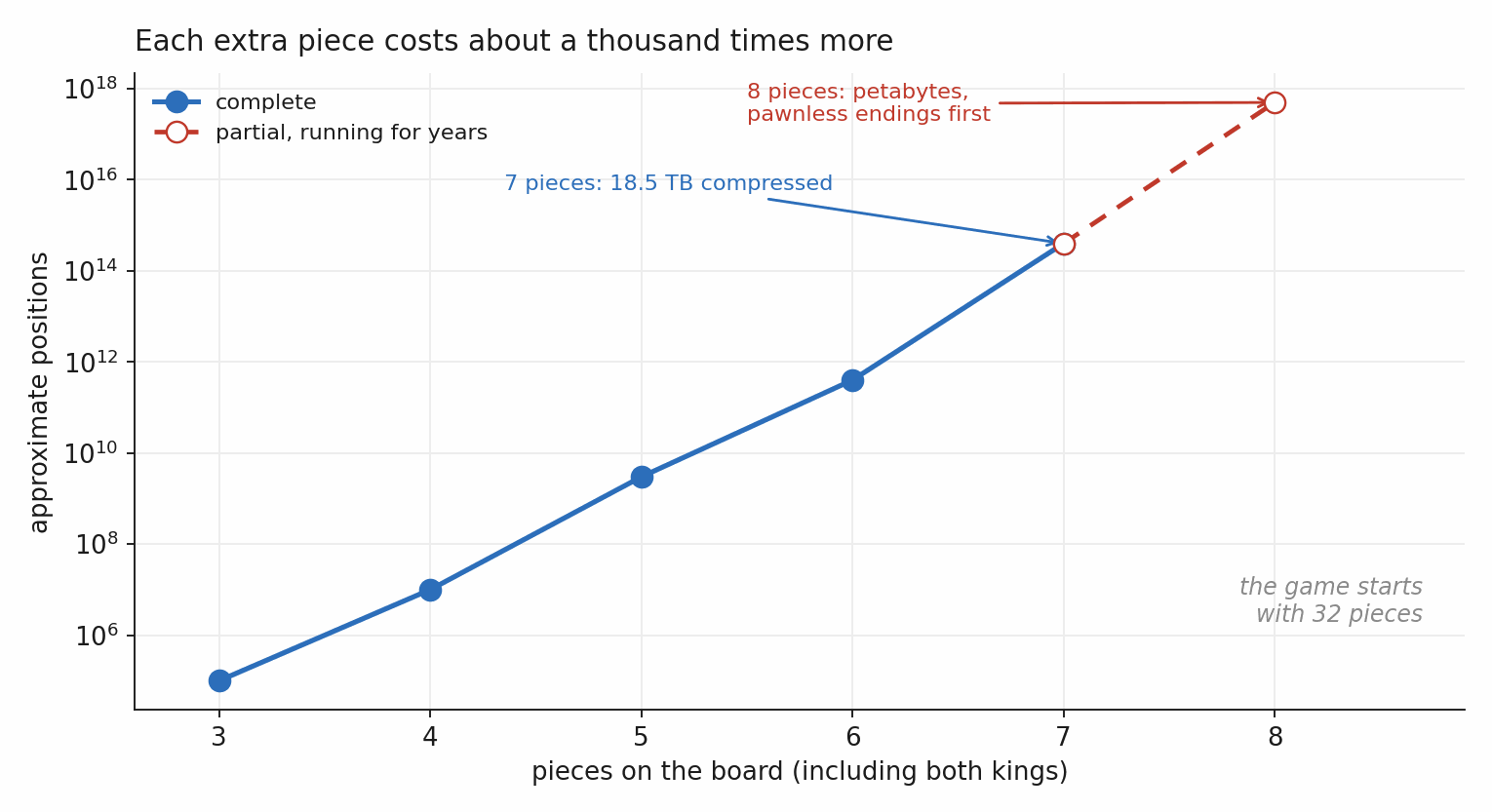 Figure 3: Nodes by piece count, log scale. Blue is finished, red has been running for years. Note where 32 would go, which is off the right of your screen and then off the right of the building. Source: Author
Each extra piece multiplies the count by roughly a thousand, because the new piece can stand anywhere in every arrangement you already had. Seven pieces is 18.5 TB in the compact Syzygy encoding and was 140 TB in the original Lomonosov format. Eight lands in the petabytes.
The ordering problem is the subtler one. These are built backwards from checkmate, so a node’s value needs the values of everything it can turn into. Captures drop you into a smaller material set and promotions drop you into a different one, so every eight-piece file sits on a stack of seven-piece files that must be finished first, and pawnless combinations go first precisely because promotion is not in their dependency graph.
Suppose somebody handed you every node
The algorithm is the easy part, four lines that tablebase generation already runs:
- Label the terminal nodes. Checkmate is a loss for the side to move, stalemate is a draw.
- Sweep the set. A node is a win if any edge leads to a node labelled a loss for the opponent, and a loss if every edge leads to a win for them.
- Repeat until a pass changes nothing.
- Whatever is still unlabelled is a draw. Read off the root.
What kills it is plumbing.
Start with storage. One label per node at two bits is about $2.5 \times 10^{43}$ bytes, against total human storage somewhere around $10^{23}$, so we are short by twenty orders of magnitude before anyone has written a line of code.
The access pattern is worse, and people forget it. This is not a stream you can chew through in chunks. Each sweep needs the predecessors of nodes scattered anywhere in the array, so it is random access across the whole thing. That is already the binding constraint at seven pieces, where the bottleneck is I/O and not arithmetic.
Thermodynamics, because I could not resist. Landauer’s limit puts the cost of erasing a bit at $kT \ln 2 \approx 2.9 \times 10^{-21}$ J at room temperature. Writing $10^{44}$ bits once, at the floor, with zero overhead, is around $3 \times 10^{23}$ J. A few centuries of total human energy production, for one pass, and forced wins in the seven-piece tables already run past 500 moves. (That arithmetic is mine. Treat it as a sanity check, not a citation.)
And the premise was false anyway. Nobody has the $10^{44}$ nodes. We have an estimate of how many there are, from two million darts.
Conclusion
Musk might be right, and the strongest version of his argument is better than the one he made. He is claiming a weak solve, and weak solves genuinely do not need the full node set. Checkers proves that. When he says the number of non-stupid moves is tiny, he is pointing at exactly the pruning that made Chinook possible. Everyone dunking on him with the atom count is refuting a claim he did not make.
Where it runs aground, for me, is his next sentence, the one about a superintelligence finding compressions we could not follow. Pruning has to be proved safe, and we have exactly one sound pruning rule for game trees. Alpha-beta: proposed by John McCarthy at the Dartmouth workshop in 1956, written up by Hart and Edwards in 1961, published by Brudno in 1963, analysed by Knuth and Moore in 1975. It discards edges that are provably irrelevant given the values already in hand. Everything a modern engine layers on top, null-move, late-move reductions, futility pruning, is a heuristic, a bet that a branch was not worth walking, which is why Stockfish is terrifying and why it proves nothing.
That is seventy years and one sound rule, and the gap is mathematical, so a compute curve does not close it on its own. Maybe a machine finds the second rule. There is no evidence that it will and none that it won’t, and I notice both sides of that thread were performing confidence about a question with no evidence on it.
So the tree was never the obstacle. Shannon knew in 1950 that you would never walk it, and everything since has been about deciding which parts you are allowed to skip. Chess stays unsolved not because the universe is too small to hold the answer, but because nobody can yet prove which branches they never had to look at.
And now you know. Fin.